
Tuesday, September 16
 Track 1: Multi-modal representation | Room Q3/0003
Track 2: Super-resolution | Q3/0007
Track 3: Image Representation & Generative AI | Q3/0009
Track 4: Multispectral & Image editing | Q3/0011
Track 5: Applications & 3D VIsion | Q3/0013
Track 6: Medical Image & Document analysis | Q4/1003

Escola Enginyeria, Edifici Q, UAB
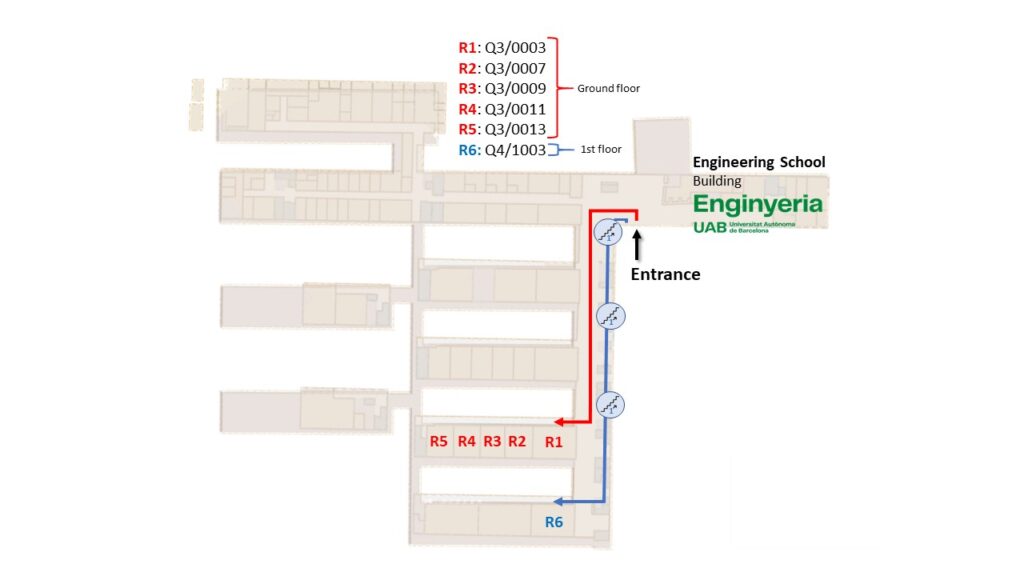
Track 1: Multi-modal representation | Room Q3/0003
14:30 | Re-Ranking Is Not Erasure: A Frontier-Normalised Study of Subspace Interventions for CLIP Debiasing | Marc Artero Pons
Abstract:
Inference-time interventions on CLIP’s expert attention heads reduce demographic skew in retrieval without retraining, but they replace a head’s entire contribution outright. We generalize the edit to removing a rank-k subspace instead and evaluate it under three controls the original protocol lacks: a label-free random subspace, a null model that traces what pure damage achieves at each utility level, and a non-linear erasure probe.
On two backbones and two attributes, low-rank editing matches the fairness of full-rank replacement while costing 2.2-4.3 fewer points of MSCOCO Recall@1, the one result in this work that holds reliably in every setting we test. A random subspace, with no demographic labels at all, reproduces a quarter to a half of the published fairness gain, and for ethnicity the published edit is in fact less fair than adding isotropic noise at matched utility. In no configuration we test does the attribute actually get erased: these interventions re-rank retrieval results; they do not remove demographic information from the representation.
Committee:
- President: Gloria Haro
- Secretary: Pau Rodriguez
- Vocal: Luis Ferraz
15:15 | Near-Zero Forgetting Is Not Enough: Out-of-Distribution Robustness in Continual Learning of Pretrained VLAs | Adrià Ruiz Puig
Abstract:
Pretrained Vision-Language-Action (VLA) models have recently demonstrated remarkable capabilities in robotic manipulation, with some studies even reporting near-zero catastrophic forgetting in specific Continual Learning (CL) settings. However, robustness to domain shift remains unexplored. In this thesis, we study the robustness of a pretrained VLA under Out-Of-Distribution (OOD) data using the LIBERO and LIBERO Plus benchmarks. While the in-domain setup achieves near-zero catastrophic forgetting, we reveal a widening performance gap under domain shifts. Specifically, we show how the continual learning process degrades OOD generalization, leading to severe collapse. Our analysis reveals that degradation depends not on the types of perturbations but on how the model’s internal representations evolve over time. These findings show that traditional in-domain stability masks hidden vulnerabilities and behaviors in the model’s representation and handling of learned tasks.
Committee:
- President: Gloria Haro
- Secretary: Pau Rodriguez
- Vocal: Luis Ferraz
16:00 | A Shared Latent Geometry of Numerical Representation in Multi-Modal Models | Oriol Juan Sabater
Abstract:
Do numerical results reached through different computations converge onto a common internal representation? We study this question in the multimodal Gemma4-12B-it model by comparing arithmetic result states across operations and input modalities. We find that task-specific causal representations occupy different coordinates, yet the changes that move the representation from one numerical value to another can be transported across text/image and addition/subtraction through simple transformations that preserve most of the destination causal effect. After separating directions coupled to the current digit readout, a readout-orthogonal component still preserves numerical geometry across tasks and unseen values, with relations consistent with a common latent frame. Crucially, this structure is functionally relevant: changing the numerical identity represented in the latent component redirects later numerical generation while largely preserving the immediately required digit. These results support a shared numerical representation in which different computational routes preserve a common geometry of numerical relationships, even though that geometry is expressed in different task-specific coordinates and transformed during generation.
Committee:
- President: Debora Gil
- Secretary: Gloria Haro
- Vocal: Guillem Capellera
16:45 | Anatomy of the Modality Gap in Self-Supervised Visual Sound Source Localization | Alejandro Donaire Salvador
Abstract:
Despite their popularity, multimodal models often exhibit an intriguing phenomenon known as the modality gap, where different modalities occupy distinct regions of a shared embedding space. We investigate this phenomenon in Visual Sound Source Localization (VSSL), where it remains underexplored. We evaluate multiple strategies for reducing the audio-visual modality gap and analyze its training dynamics, relationship with downstream performance, and other relevant properties. Moreover, we conduct a comparative analysis of existing modality-gap metrics through controlled synthetic scenarios, revealing limitations in standard measures, and propose Nearest Neighbor Overlap at k (NNO@k) as a robust alternative. Our results show that the modality gap is persistent and difficult to eliminate, and highlight a weak but recurring association between a smaller gap and better downstream performance.
Committee:
- President: Coloma Ballester
- Secretary: Lluís Gómez Bigorda
- Vocal: Dipam Goswami
Track 2: Super-resolution | Room Q3/0007
14:30 | Exploring Semantic Consistency in Image Super-Resolution | Valentin Micu Hontan
Abstract:
While modern diffusion-based super-resolution models produce high-quality reconstructions, they are prone to hallucinations that may alter image content—rendering text into different words, changing structures of local objects, or even altering overall image semantics entirely. Current quality metrics focus primarily on perceptual realism rather than content fidelity, leaving these semantic distortions underexplored. To bridge this gap, we propose a four-category taxonomy of semantic change between a reference image and its reconstruction. Based on this, we construct a benchmark dataset of 10,017 image pairs reconstructed by fifteen super-resolution methods. To enable scalable and cost-effective evaluation beyond laborious human annotation, we develop an automatic labelling pipeline combining both VLM and LLM annotations. We validate its accuracy through a blind annotation study on a 104-pair subset with four hidden controls. When evaluated against the human majority vote stratified by inter-annotator agreement, our pipeline demonstrates strong alignment with human perception, achieving an F1 score of 0.86 on localised detail changes and 0.35 on holistic semantic shifts.
Committee:
- President: Xavier Baró
- Secretary: Sanket Biswas
- Vocal: David Serrano Lozano
15:15 | Rethinking Perception-Distortion Trade-off in Image Super-Resolution with Uncertainty Modeling | Bernat Medina Pérez
Abstract:
Super-resolution reconstructs a high-resolution image from a single low-resolution observation, and the mapping is fundamentally uncertain: many distinct reconstructions are consistent with the same input, yet current evaluation protocols score a single output against one reference with a fixed criterion, regardless of how much freedom the reconstruction actually had. We estimate this uncertainty from the disagreement between independently seeded runs of stochastic super-resolution models, a signal that requires no human annotation, built at three degradation severities over ten thousand images and three models. The resulting dataset pairs each degraded observation with its reference, so a predictor can be trained on the low-resolution input alone, on the reference alone, or on both together. We train a restoration transformer on this data to predict the uncertainty map from a single image, without access to the reference, and report a deployability gap: configurations that also see the reference score better, but only the reference-free one is usable at test time. We then use the predicted signal to rethink how super-resolution quality should be assessed under the perception-distortion trade-off, proposing a metric that balances perceptual and distortion-based scoring according to predicted uncertainty.
Committee:
- President: Pablo Arias
- Secretary: Xavier Baró
- Vocal: Xavier Juanola
16:00 | Deep Learning-Based Super-Resolution in Hybrid Confocal Structured Illumination Microscopy | Adrián García Tapia
Abstract:
Hybrid Confocal Structured Illumination Microscopy (Confocal-SIM) provides enhanced sub-diffraction lateral resolution by illuminating the sample with a set of structured light patterns, yet reconstructing high-frequency biological details from these multi-pattern illumination stacks remains computationally challenging. This work evaluates the viability and performance trade-offs of diverse deep learning architectures simplified to 2D single-axial-plane reconstruction. We benchmark single-image vision transformers (Swin2SR, HAT), continuous implicit representations (GSASR), and a proposed multi-frame cross-attention architecture (XL-SIM). All models are evaluated using a two-stage training paradigm combining dynamic optical physics simulation on LSDIR with LoRA fine-tuning on single-plane biological data from the BioSR dataset. Results indicate that while explicit multi-frame attention in XL-SIM yields slight PSNR improvements, it comes at a substantial computational efficiency penalty compared to lighter baselines. This comparative study highlights key architectural trade-offs for 2D lateral super-resolution, establishing a baseline for future work on multi-slice volumes and out-of-focus background noise.
Committee:
- President: Xavier Baró
- Secretary: Shaolin Su
- Vocal: Artur Xarles Esparraguera
16:45 | Transferability of a Transformer-based Single-Image Super-Resolution Model to Microscopy Images: Performance Evaluation, Adaptation and Uncertainty Estimation | Lore Oregi Lauzirika
Abstract:
Transformer-based single-image super-resolution (SISR) models have achieved state-of-the-art performance on natural images, yet their applicability to microscopy—a domain marked by scarce training data and stricter fidelity requirements—remains largely unexplored. We evaluate Wavelettention, a representative Transformer-based SISR model, on two microscopy datasets (EM-Kasthuri, 4×; F-actin, 2×), benchmarking it against eight established SISR models and investigating three targeted extensions: stronger data augmentation, a perceptual loss term, and pixel-wise uncertainty estimation. Wavelettention matches or exceeds the benchmark models on artifact-related metrics without compromising performance on pixel-based or perceptual metrics, and this competitiveness is shown to be largely independent of ImageNet pretraining. The effects of data augmentation and perceptual loss are found to be strongly dataset-dependent, while a lightweight uncertainty network provides an informative, near-free proxy for reconstruction quality, alongside characterized limitations.
Committee:
- President: Jorge Bernal
- Secretary: Xavier Baró
- Vocal: Shaolin Su
Track 3: Image Representation & Generative AI | Room Q3/0009
14:30 | Seeing What the Model Sees: Sparse-Autoencoder Interpretation of PaliGemma’s Visual Encoder | Marina Rosell Murillo
Abstract:
Vision-language models such as PaliGemma encode an image through a deep vision transformer before producing any text, and what those representations carry is unclear. This work builds a per-layer, human-readable account of PaliGemma’s SigLIP visual encoder without using its text output. Direct vocabulary projection proves unreliable, so we train sparse autoencoders on patch activations at several depths and label their features automatically. Feature meaning tracks depth, from colour and texture near the input to objects and scenes later. We also find fixed high-norm outlier patches that fit neither the register nor the massive-activation outliers described for other ViTs, and that induce some features responding to position rather than image content. Steering individual content features confirms that they are used causally during generation.
Committee:
- President: Serkan Sulun
- Secretary: Lluís Gómez Bigorda
- Vocal: Maria Vanrell Martorell
15:15 | Identifying Nature Representations On Images | Pau Monserrat Llabrés
Abstract:
The BIG-5 project investigates how digital platforms shape perceptions and values of nature. A key challenge is the automatic identification of nature representations in large image datasets. While prior work framed this task as closed-set classification [1], its reliance on a predefined label space limits its utility and reliability in unconstrained scenarios. To address this issue, we propose a novel approach based on three key ideas: (a) reformulating the task as a Visual Question Answering (VQA) pipeline; (b) establishing a framework for ground-truth adaptation and evaluation aligned with the BIG-5 nature categorization; and (c) evaluating state-of-the-art Vision-Language Models (VLMs) on the proposed benchmarks. The results show that Gemma-4-26B-A4B achieves a 23.7% improvement in our benchmark over the prior closed-set approach, providing a robust foundation for nature entity identification in a wide variety of images.
Committee:
- President: Alexandra Gómez Villa
- Secretary: Andrey Barsky
- Vocal: Coloma Ballester
16:00 | CycleDrift: Revisiting Cycle Consistency for One-Step Unpaired Image-to-Image Translation | Diego Hernández Antón
Abstract:
Cycle consistency enabled unpaired translation; however, modern diffusion models cannot leverage it directly due to the prohibitive cost of backpropagating through iterative denoising steps. In contrast, recent drifting models generate images in a single function evaluation without adversarial losses, making cycle constraints computationally feasible for training. We therefore introduce CycleDrift, combining diffusion-grade sample quality with efficient one-step generation for translation between unpaired domains. We first extend unconditional drifting models beyond ImageNet, the sole image domain used in the original work, and then realize CycleDrift by coupling two single-step generators under a non-adversarial distribution-matching objective. As this results in a deterministic mapping, we further propose Augmented CycleDrift, which restores multimodality by sampling styles from a discrete codebook and recovering them via a lightweight encoder, discarding the discriminators and regularization terms that continuous approaches use. Across seven datasets, CycleDrift achieves superior realism on the largest two benchmarks, reducing FID by 43\% on CelebA-HQ ($\text{male} \to \text{female}$) compared to the state-of-the-art diffusion translator while running $122\times$ faster. Without compromising visual quality, Augmented CycleDrift synthesizes diverse, style-consistent outputs. Finally, we discuss the remaining challenges and practical limitations of our approach.
Committee:
- President: Alexandra Gómez Villa
- Secretary: Pablo Arias
- Vocal: Javier Vazquez Corral
16:45 | Autoregressive Diffusion for Long-Horizon Multi-Agent Generation | Xavier Pacheco Bach
Abstract:
Generative models for multi-agent sports dynamics are usually trained on short, fixed-length windows, which limits them to generating bounded segments rather than complete plays. Extending them autoregressively removes this limit, but forces the model to condition on its own imperfect outputs, causing the generated dynamics to drift as the rollout grows.
In this work, we extend JointDiff, a diffusion model that jointly generates player and ball trajectories together with possession states, to long-horizon autoregressive generation in football. Evaluating this setting is challenging because, as the horizon increases, many different futures may remain plausible, making direct comparison with a single recorded continuation increasingly uninformative. We therefore introduce a distributional evaluation framework that tracks how kinematic, tactical, and ball-interaction properties evolve with the generation horizon, revealing a clear increase in distributional drift as the autoregressive horizon grows.
We then investigate three strategies to reduce this drift: fine-tuning on self-generated errors, conditioning on information from earlier parts of the play, and guiding each new window with a predicted future ball route. The latter, RouteGuid, performs best, reducing global drift by about 45% relative to the autoregressive baseline, with similar relative gains when training data is scaled up fivefold. Finally, to move beyond fixed horizons, we introduce explicit play-termination modelling, enabling variable-length generation.
Committee:
- President: Montse Pardàs
- Secretary: Fan Lyu
- Vocal: David Masip
Track 4: Multispectral & Image editing | Q3/0011
14:30 | Multispectral 3D Scene Representation and Reconstruction via Gaussian Splatting from Partial Spectral Observations | Jordi Ventosa Altimira
Abstract:
Three-dimensional multispectral reconstruction currently requires dedicated hyperspectral cameras and yields a handful of discrete bands. This thesis develops an alternative route using only an RGB sensor, a fisheye lens and a small set of interference filters. It exploits the blue shift: the passband of an interference filter slides towards shorter wavelengths as the angle of incidence grows, so a single filter in front of a fisheye lens presents a different passband at every pixel, turning one capture into a dense angular sweep of spectral measurements. The work proceeds in three validated stages. A 2D study shows that material reflectance can be recovered from filtered RGB measurements — a learned ridge regressor reaches a spectral angle of $2.8^\circ$ — and shows why: the forward operator is severely rank-deficient, so recovery depends on the prior, and methods rank by how much they rely on the explicit operator at prediction time, with purely learned mappings ahead of hybrid inversions and closed-form inversion last. A benchmark of wide field-of-view Gaussian Splatting backbones identifies 3DGUT as the only one to reconstruct a raw, unprocessed fisheye capture without retuning, an advantage traced to its densification schedule rather than its projection model. Their combination yields a 3D reconstruction in which every Gaussian carries a reflectance spectrum supervised through the filtered fisheye forward model: a low-dimensional feature shared across wavelengths, decoded by a smoothness- and non-negativity-constrained head, recovers spectra at $10.1^\circ$ spectral angle against a $24.6^\circ$ flat-spectrum baseline, whereas per-band storage and unconstrained decoders produce spectra worse than a constant despite higher image PSNR. A residual forward-model gap, largest at near-normal incidence and not closed by re-fitting the camera characterisation, remains the main open limitation.
Committee:
- President: Pablo Arias
- Secretary: Coen Antens
- Vocal: Javier Vazquez Corral
15:15 | Exploring Refractive Index Recovery from Multi-View Polarization Images with Gaussian Splatting | Arnau Marcos Almansa
Abstract:
The way a surface polarizes reflected light depends on its refractive index. Optical metrology exploits this to measure the index under controlled conditions: known light, known angle, single view. This thesis explores whether the index can be recovered in a far less constrained setting, a Gaussian Splatting scene built from multi-view images, where geometry, illumination and reflectance are all unknown and estimated together.
We extend a polarimetric Gaussian Splatting renderer so that every surface element carries a spectral reflectance and a wavelength-dependent refractive index, shaded physically per wavelength and projected onto the camera bands. To test it we build a filter-wheel polarization camera rig, a preprocessing pipeline, a synthetic dataset with material ground truth, and measure five real materials on the same rig as a reference.
The renderer reproduces its RGB reference and reconstructs real spectro-polarimetric scenes at 22 to 32 dB with 4 to 9 degrees of polarization angle error. On synthetic data, the model picks the correct material for all four objects from a set of known glasses, with no supervision on the index. Left free, the index moves toward the true value but does not settle, on real or synthetic data; the unmodified base method behaves the same way. We trace the cause to an ambiguity between the index and the estimated reflectance and illumination, and identify the measurement changes that would reduce it.
Committee:
- President: Joan Serrat Gual
- Secretary: Javier Vazquez Corral
- Vocal: Coen Antens
16:00 | CHROMA-MILL: Joint Low-Light Enhancement and White Balance under Colored and Mixed Illumination | Pol Riubrogent Comas
Abstract:
Capturing an image in a low-light environment produces a weak, noisy sensor signal. Low-light image enhancement (LLIE) aims to restore it. Auto white balance (AWB) is also required for every image, and the same noisy signal degrades its ability to infer the scene illuminant. LLIE is typically performed first, followed by AWB, but this strategy remains largely unexamined because existing low-light datasets span a narrow range of illuminants and lack illuminant ground truth for evaluating AWB. We address this using CHROMA-MILL, a previously unreleased colored-illuminant extension of the MILL dataset, exploited here for the first time: 50 RAW scenes captured with a DSLR and a smartphone under four calibrated illuminants at eleven intensity levels. Because light is additive, we blend these captures in the linear RAW domain to synthesize physically valid illuminant mixtures with exact chromaticity ground truth. Benchmarking on this data, we find joint correction is best, and introduce CTI-Retinexformer, which supervises an illumination map, a chromaticity prediction, and an illumination-invariant scene embedding.
Committee:
- President: Muhammad Atif Butt
- Secretary: Gemma Piella
- Vocal: Xavier Otazu
16:45 | PICASSO: Palette-based Interactive Colour And Style Splatting Optimisation | Maiol Sabater Oliveras
Abstract:
Style transfer for 3D Gaussian Splatting is typically organised as two stages, a recolouring step followed by a stylisation step. Such methods provide rich artistic control, but they expose no structured palette interface for precise colour manipulation. Palette-based methods, in contrast, excel at semantic, region-aware colour control, yet they are confined to colour-level edits and lack stylistic expressiveness. We present a method that bridges these two worlds: it offers full control of colour, driven either by an explicit palette or by a style image, together with control over the stylisation itself. Working in the chroma (ab) plane of CIE~Lab on the view-independent base colour of each Gaussian, our framework aligns the scene palette to the target and propagates the edit across millions of primitives while preserving per-Gaussian lightness, and it further exposes per-palette tone curves for explicit control of shading. We demonstrate consistent, view-coherent stylisation on real captured scenes.
Committee:
- President: David Serrano Lozano
- Secretary: Ramon Baldrich Caselles
- Vocal: Federico Sukno
Track 5: Applications & 3D Vision | Q3/0013
14:30 | Permutation-Invariant Sequential-Set Representations for Multi-Agent Sports Trajectories | Benet Ramió Comas
Abstract:
Football tracking data records the trajectories of 22 players and the ball, but the index assigned to each player is an artifact of the data pipeline, not a meaningful signal: swapping two teammates’ rows changes nothing about the play. This thesis adapts an existing permutation-invariant sequential-set variational autoencoder (VAE) toward a richer, more structured latent representation, rather than reconstruction fidelity alone. Two additions drive this: a temporal-smoothness regularizer and a latent-attached classifier predicting each play’s game state, both selected through a chronological ablation study. The representation is validated primarily through multi-granularity similar-play retrieval, checked against ground truth by PI-SADE, a permutation-invariant physical displacement metric computed via Hungarian assignment within agent groups. Retrieval error falls from 10.65 m to 8.95 m at the final model, consistently outperforming every earlier milestone across every retrieval rank. Active-unit and temporal-coherence diagnostics track the same improvements throughout. As a further exploratory step, the representation is examined as a feature extractor for the Fréchet Set-sequence Distance (FSD), analogous to FID and FVD, which behaves cleanly under permutation and physical-noise perturbation. Together, these results show a practical route to permutation-invariant, temporally coherent multi-agent embeddings, validated through retrieval and left open for broader downstream use.
Committee:
- President: David Masip
- Secretary: Josep Llados Canet
- Vocal: Artur Xarles Esparraguera
15:15 | Temporal Representation Learning for Optimal Cutting Time Detection in Milk Coagulation | Daniel Pardo Navarro
Abstract:
The determination of the optimal cutting time is a critical decision in cheese production. This project studies image sequences from milk coagulation processes, where each process is treated as an independent Set and the cutting time is annotated by an expert. Instead of addressing the problem as frame-level binary classification, the task is reformulated as temporal representation learning. Temporal supervision is defined in seconds relative to the cutting point, avoiding class definitions based on a fixed number of frames.
Pretrained visual backbones are used to extract image features, and different projection Head configurations are evaluated. The main approach combines temporal triplet loss with an auxiliary temporal regression objective, aiming to learn embeddings that preserve information about the progression of coagulation. Evaluation is performed using Leave-One-Set-Out validation to avoid leakage between correlated frames. Raw backbone embeddings and learned embeddings are compared using kNN probes, temporal error, ordering metrics, and the proposed causal utility metric focused on the first cutting decision.
Committee:
- President: Jorge Bernal
- Secretary: Carles Ventura Royo
- Vocal: Artur Xarles Esparraguera
16:00 | Registering LiDAR pointclouds for collaborative perception in autonomous driving | Aleix Armero Rofes
Abstract:
Cooperative perception has emerged as a key enabler for autonomous driving, allowing vehicles to extend their perceptual range and robustness by sharing sensor data with other vehicles and roadside infrastructure. Among the different collaboration modes, vehicle-to-infrastructure (V2I) cooperation is particularly attractive, as infrastructure sensors offer a stable, elevated viewpoint largely unaffected by the vehicle’s own occlusions. Realizing this benefit, however, requires an accurate estimate of the rigid transformation between the vehicle and infrastructure sensors, which can be recovered via point cloud registration. This problem differs substantially from the scan-to-scan setting for which most registration methods are designed: V2I registration involves large viewpoint separation, limited and variable overlap, and an initial pose estimate that aggregates the localization errors of both agents. This work evaluates the applicability of Voxelized Generalized ICP (VGICP), a classical, feature-free registration method, to the V2I setting on the V2X-Real dataset, contrasting its behavior against the standard scan-to-scan case. We introduce a controlled noise model to characterize VGICP’s tolerance to initialization error, propose a sequential initialization strategy that reuses each frame’s estimated transformation to initialize the next, and study the effect of multiple VGICP variations on accuracy and runtime. Findings are applied on real-world data captured in the 6GEWOC project, for which no ground truth is available.
Committee:
- President: Andrey Barsky
- Secretary: Montse Pardàs
- Vocal: David Masip
16:45 | HandAffordSplat: Handle Affordance Prediction on 3D Gaussian Splats with Language-Guided Object Segmentation | Gerard Vilaplana Pelegrí
Abstract:
This thesis introduces HandAffordSplat, a framework for language-guided affordance prediction on 3D Gaussian Splatting representations. The work addresses the gap between language-grounded 3D scene understanding, which mainly focuses on identifying and localizing objects, and affordance prediction, which determines how objects can be interacted with. HandAffordSplat integrates natural-language object extraction with affordance prediction, enabling handle affordances to be identified directly on the Gaussian representations of objects specified by language queries, without requiring ground-truth object masks at inference time. A 3D training dataset is constructed from HANDAL by reconstructing annotated image sequences, extracting object-level Gaussian representations, and lifting 2D handle masks into per-Gaussian labels. The framework uses a PointNet-style architecture that combines Gaussian geometry and appearance with multi-view DINOv2 visual features. The best configuration achieves 0.855 mIoU on unseen instances from seen object categories and 0.675 mIoU under leave-one-category-out evaluation.
Committee:
- President: Carles Ventura Royo
- Secretary: Xim Cerda Company
- Vocal: Oriol Jiménez-Ayguadé
Track 6: Medical Image & Document Analysis | Q4/1003
14:30 | Efficient Segmentation of Kidney Anatomical Structures in B-mode Ultrasounds via Self-Supervised Learning: Towards IFTA score prediction for Non-Invasive Histological Damage Assesment | Biel Gonzalez Garriga
Abstract:
Chronic injury in kidney allografts is clinically quantified by Interstitial Fibrosis and Tubular Atrophy (IFTA) scores derived from the Banff classification. Obtaining ground-truth IFTA grades requires a percutaneous biopsy—an invasive, risk-bearing procedure with potential sampling variability that limits frequent longitudinal monitoring. Conversely, standard B-mode ultrasound offers a safe, non-invasive alternative but currently lacks the quantitative precision required to track microstructural tissue degradation, yielding largely qualitative and operator-dependent observations.
This thesis explores whether domain-specific machine learning can bridge this clinical gap by transforming routine renal B-mode ultrasound into accurate, quantitative estimates of histological damage. To address the scarcity of paired biopsy-ultrasound data (a single-center cohort of 254 patients), we implement a self-supervised pre-training strategy combining Bootstrap Your Own Latent (BYOL) and Pixel Propagation (PixPro) on external unlabelled datasets (OKUD and URI-CAD). The pre-trained ResNet-34 encoder is then integrated into a modified Attention U-Net designed to segment three key renal compartments: whole kidney, cortex, and medulla. The segmentation architecture incorporates concurrent spatial and channel Squeeze-and-Excitation (scSE) blocks, bottleneck self-attention, and a dynamic six-phase composite loss function combining Focal, Tversky, and Boundary terms. Downstream models extract a 2,063-dimensional representation—merging global bottleneck features, region-masked soft pooling, and shape descriptors—which are reduced via PCA and classified across five clinical target formulations using nested patient-level cross-validation.
The segmentation pipeline achieves robust multi-compartment performance with a mean test Dice score of 0.921, maintaining high fidelity across the renal capsule (0.958), cortex (0.882), and thin medullary structures (0.876). Joint BYOL+PixPro pre-training demonstrates superior generalization over instance-only baselines, yielding lower HD95 (9.99 px) and ASSD (1.87 px) boundary distance metrics on unseen test data. Downstream clinical predictions show that features derived specifically from the renal cortex and geometric descriptors carry substantial discriminative signal for tracking continuous IFTA percentage as well as Banff components (interstitial fibrosis ci and tubular atrophy ct).
In conclusion, combining non-contrastive self-supervised pre-training, attention-guided anatomical segmentation, and interpretable classification demonstrates that B-mode ultrasound carries sufficient quantitative signal to track histological allograft damage, presenting a promising framework toward non-invasive, longitudinal post-transplant surveillance.
Keywords: Kidney Allograft, Interstitial Fibrosis and Tubular Atrophy (IFTA), B-mode Ultrasound, Self-Supervised Learning, Attention U-Net, PixPro, Quantitative Biomarkers.
Committee:
- President: Debora Gil
- Secretary: Joan M Núñez do Rio
- Vocal: Gemma Piella
15:15 | Semantically Controlled Synthetic Data Generation for Cutaneous Ulcer Tissue Segmentation | Júlia Garcia Torné
Abstract:
Cutaneous ulcer tissue segmentation can support objective wound assessment by quantifying the spatial distribution of clinically relevant tissue types. However, the development of supervised segmentation models is strongly limited by the scarcity and class imbalance of pixel-level tissue annotations. This work investigates whether semantically controlled synthetic data can be used to increase the amount and diversity of supervision available for this task.
The proposed framework separates wound appearance modelling from semantic tissue-layout generation. First, Stable Diffusion 3.5 Medium is adapted to the wound domain through Low-Rank Adaptation (LoRA) using a large collection of RGB wound images with binary ulcer masks. A semantic ControlNet, trained from a substantially smaller tissue-annotated dataset, introduces spatial control over five target categories: granulation, slough, necrosis, epithelial tissue, and maceration. Second, a conditional probabilistic U-Net is trained to generate plausible multi-tissue semantic layouts from binary wound geometry, requested tissue presence and proportions, and a stochastic latent representation. These components are subsequently combined to transform wounds for which only binary annotations are available into synthetic RGB–semantic-map pairs.
Particular attention is given to the semantic consistency between generated appearance and the corresponding synthetic labels, since perceptual realism alone does not guarantee that a generated sample provides reliable supervision for semantic segmentation. A quality-control stage is therefore incorporated to identify and discard synthetic pairs with substantial visual or semantic inconsistencies.
The usefulness of the resulting synthetic data is evaluated through downstream tissue segmentation using a fixed SegFormer-based training protocol. Real-only baselines, controlled real-data training conditions, and different amounts of curated synthetic data are compared on held-out real clinical images and across multiple random seeds. The study aims to determine not only whether synthetic augmentation can improve overall segmentation performance, but also how its impact varies across individual tissue categories.
Overall, this work provides a framework for exploiting weakly annotated wound datasets through semantically controlled generative modelling and investigates the conditions under which synthetic image–label pairs can provide useful supervision for real-domain medical image segmentation.
Committee:
- President: Joan M Núñez do Rio
- Secretary: Gemma Piella
- Vocal: Jordi Sanchez Riera
16:00 | Agentic Graph RAG: Unifying Modular Multi-Agent systems over Structured Graph-based Retrieval for Document Question-Answering. | Souparni Mazumder
Abstract:
Multimodal document understanding has shifted from OCR pipelines to vision-language models that read whole pages directly. Yet, standard retrieval methods still rely on flat text chunks, discarding the spatial and structural layout essential for document Question-Answering. To address this we propose a Agentic Graph RAG DocQA that unifies modular agentic execution with Graph RAG. We adopt graph representations because they explicitly capture non-linear relationships across evidence. Unlike text-centric graphs, our multimodal graph models both semantic and geometric ties across text, tables, charts, and layout. This ensures critical visual context, such as table headers or chart axes, is neither discarded by text-only RAG nor rendered opaque by end-to-end reading. Seven specialized agents, handling retrieval, route planning, visual localization, grounding, computation, reading, and verification, operate over this shared graph. They communicate strictly through provenance-backed evidence, regulated by a cost-aware budget controller. Evaluated on a 1,175-question benchmark( including DocVQA, ChartQA, InfographicVQA,TATQA), our system achieves 0.5987 accuracy compared to 0.5907 for a direct page reader, highlighting a key accuracy-cost trade-off.
Committee:
- President: Xim Cerda Company
- Secretary: Jordi Sanchez Riera
- Vocal: Ernest Valveny Llobet
16:45 | From Occluded Text to Occluded Structure: Recovering Destroyed Content in Document Images | Kunal Purkayastha
Abstract:
Degraded documents lose content, and the lost content has to be inferred rather than merely enhanced. This thesis develops methods for that problem: localise the damage, infer what is missing in a representation that carries the right constraints, and render the inference back in the source style. It applies this approach at two levels. Part I takes the whole page and recovers occluded text, where the representation is language and comes for free. We develop a unified pipeline that couples OCR, occlusion detection, geometry-driven blank extraction, a document-adapted masked language model, and diffusion-based text editing, and is benchmarked on 30,078 degraded pages and a context-aware metric. Part II narrows the target to the structured figures of scientific document pages, where no masked language model exists for a schematic. We benchmark the method on different types of structured figures. Chemical diagrams are chosen as the first one because they are highly structural and hard to infer. An ablation study shows that recognition and rendering degrade on different scales, and that the system returns a well-formed but wrong answer in 76.4% of the cases it fails, so evaluation catches syntactic and not semantic error. A single model is then trained over three families at once, namely molecules, flowcharts, and circuits, each with its own grammar and validator, under occlusion stratified from 3% to 35% of ink and other types of occlusions. Recovery transfers in proportion to how over-determined each grammar is, or the chemistry or the underlying knowledge, chosen for being the most measurable family, proves to be the hardest; i.e., exact match halves after 6.3% of the molecule is hidden, against 13.8% for a circuit and 30.4% for a flowchart.
Committee:
- President: Alicia Fornes
- Secretary: Sanket Biswas
- Vocal: Xavier Otazu
17:30 | Offline Generation of Synthetic Musical Symbol Images with Spiking Neural Networks | Gerard Asbert Marcos
Abstract:
Handwritten Optical Music Recognition is constrained less by architectures than by annotated data. Existing synthesis pipelines composite real glyph instances onto rendered staves, and therefore inherit rather than extend the diversity of the source corpora, while adversarial and diffusion generators able to create new glyphs require the very data whose absence defines the problem. We instead change the learning substrate, generating offline images of handwritten musical symbols with a recurrent spiking neural network trained by eligibility propagation (e-prop), a local, forward-in-time rule whose credit assignment is aligned with the network’s own dynamics. The central obstacle is structural: a spiking network emits an ordered stream, whereas the target is a static image. We treat the map between them as the principal design variable and report the progression it entails, from rendering an emitted trajectory, through a whole-image raster, to a column-wise sweep in which each column is drawn by a small set of parametric Gaussian stroke slots. Conditioning through frozen Poisson spike trains factorises symbol identity from scribal hand, allowing unseen symbol–writer combinations and continuous style interpolation.
Committee:
- President: Federico Sukno
- Secretary: Lei Kang
- Vocal: Josep Llados Canet


